A Developing Story, Read in Three Passes
Read a developing local story in three passes to separate confirmed details, track what has changed and return to unresolved points with a clear plan.
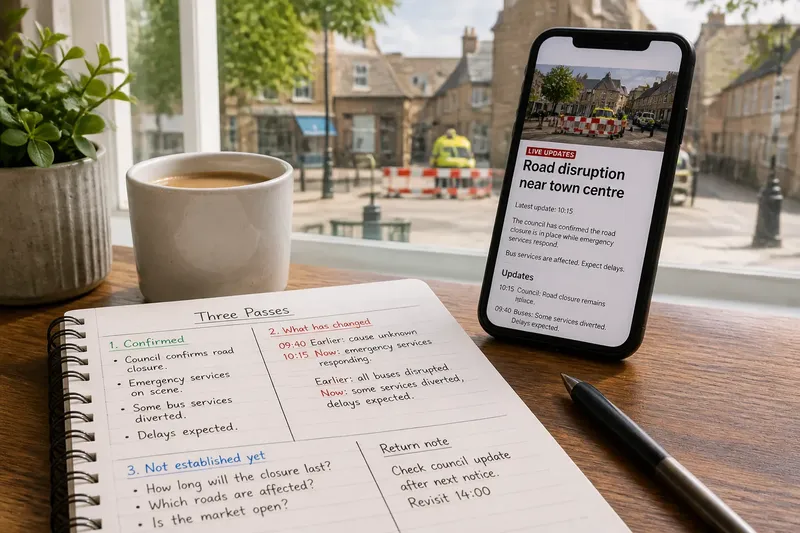
A developing local story can change between your morning commute and the school pick-up. Read it in three passes: first for what is confirmed, then for what has changed, and later for what remains unresolved. This routine helps you follow events without treating every new alert as a settled account.
What can you confirm on the first pass?
Start with the latest version, but do not assume that “latest” means complete. Read the article from the top through its update notes, if it has them, and mark claims that are clearly attributed: a council statement, a named witness, a police notice, or a reporter’s direct observation.
Keep a small note with two headings: Confirmed in this report and Not established yet. Under the first, write only details the story supports in plain terms. Under the second, put unanswered questions, not guesses about what the answers might be.
Pay attention to how a detail is presented. “The road is closed,” attributed to a current council notice, is different from “the road may close,” based on a resident’s account of a planned works sign. The distinction is not a judgement about the source; it is a record of what the report can currently support.
For a story about a disruption near a familiar place, note the location as precisely as the report allows. “Near the station” may leave several entrances or streets in play. Avoid filling in the map from memory unless the article names the junction, building or service involved.
How do you track what has changed?
On the second pass, compare the current report with the version you saw earlier. If the page has a timestamp or update note, use it; otherwise, compare your saved link, browser history or a brief note from the first reading. Look for changes in the event itself, the stated cause, the people affected and the next expected action.
Record the change as a before-and-after pair, keeping the wording neutral:
- Earlier: officials said a decision was pending. Now: the council has announced a decision.
- Earlier: the service was reported as disrupted. Now: the operator says it has resumed, while delays continue.
- Earlier: the cause was unknown. Now: a named authority has offered a preliminary explanation.
These are invented, general patterns, not reports of real events. The useful habit is to capture what changed without silently replacing the earlier account. An update can clarify a point, narrow it or introduce a new claim; those are different kinds of movement.
Say you read that a market square will be closed during an incident response, then see a later update saying only one entrance is restricted. Note both statements and the time attached to each. The observable result is a more accurate record of the current access information, while the earlier closure remains part of the story’s timeline rather than a mistake you have to erase.
It is not worth refreshing the page repeatedly just to catch every wording adjustment. If the story does not affect something you need to do now, make one clear note and return at a useful interval or when a stated update is due.
What should you leave unresolved for now?
On the third pass, return to the questions in your “Not established yet” column. For each one, ask whether the story has answered it, whether a new source has addressed it, or whether it remains open. Leave it open if the reporting still does not support an answer.
Separate a missing detail from a contradiction. If one account says a meeting is postponed and another says it will go ahead, note the difference and check whether they refer to the same meeting, date and venue. A changed plan, a misunderstanding and conflicting accounts can look alike in a short alert.
Make a short return note with three parts: the unresolved point, the source or update that could address it, and when you will check again. For example: “Is the community hall open to residents? Check the council service update after its next notice.” This keeps the question attached to a useful route back, rather than letting speculation fill the gap.
When the next update arrives, read the relevant passage in context rather than relying on a notification preview. A headline may stay unchanged while the body adds a qualification, or the opening paragraph may be rewritten without explaining what prompted the change. Look for the actual new wording and any indication of who supplied it.
Which questions help on a developing local story?
Should you trust a live blog more than a later article?
Use each for what it offers: a live blog can preserve a sequence of updates, while a later article may organise confirmed information more clearly. Neither format makes every claim equally settled, so check attribution and timestamps in either one.
What does “developing” tell you?
It signals that the account may change as reporting continues, not that every detail is doubtful. Keep confirmed claims distinct from open questions and note when the report was updated.
How can you tell whether an update changes the account?
Compare the specific claim, not just the headline. Ask whether the new wording adds a fact, corrects an earlier detail, narrows the scope or simply repeats what was already reported.
When should you stop checking?
Stop when the story no longer affects a decision you need to make and there is no useful update expected. Keep your unresolved note if the issue may matter later, then return when a named authority, service or reporter has something relevant to add.
How can you keep the story tied to its place?
Local reports often use place names that mean different things to different readers: a neighbourhood, a ward, a high street or a whole service area. Copy the location as reported, then note any practical boundary the story gives, such as a named entrance, stop or stretch of road. Do not extend that boundary to nearby streets without support in the report.
Also note who is affected and who is merely mentioned. A notice about a school entrance may concern pupils and carers using that entrance, not every school in the district. Keeping the affected group specific prevents a narrow update from turning into a broad impression about the area.
For this kind of developing local story, the three passes are a simple record: what the report supports now, what has changed since you last read it, and what still needs an answer. Keep the notes brief enough to revisit, and let the next report—not the pressure to have an immediate explanation—close the open points.