Before the Decision: Finding the Background a Local Story Needs
Build context for a local decision by tracing the question, earlier events and unresolved details behind a news story, without mistaking gaps for answers.
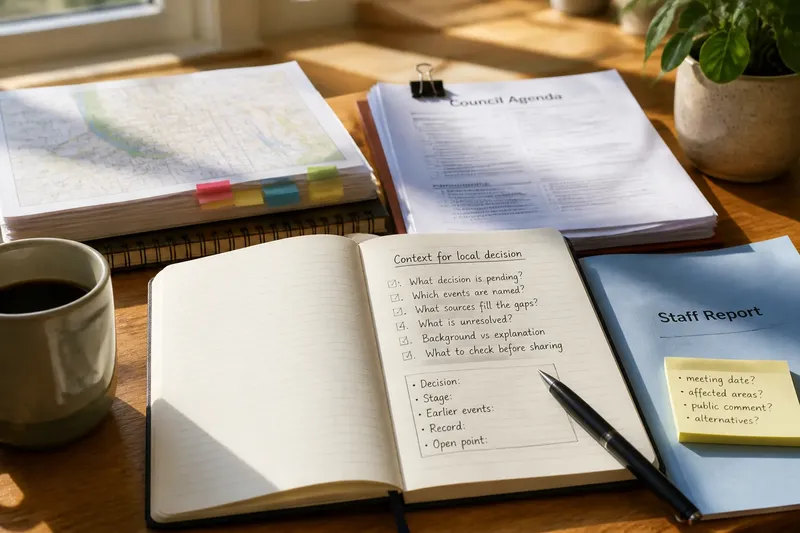
To build context for a local decision, start with the question officials are being asked to answer—not with the loudest reaction to it. A council story about closing a library branch, for instance, makes more sense once you know what decision is pending, what events led to it and what the coverage still has not established.
Use the numbered checks below to assemble that background. They are designed to keep separate what is on the record, what is reported as history and what remains open.
1. What decision is actually pending?
Find the sentence that states what a public body may approve, reject, fund or change. A proposal, a staff recommendation and a final vote are different stages; a story can discuss all three in the same breath, so mark which one is current.
Then identify who has authority to act. A school board may decide a school’s operating plan, while a separate agency controls the bus route serving it. If coverage does not name the decision-maker or the action under consideration, treat that as an unresolved point rather than filling it in from the headline.
Write the decision as a plain question: “Will the council approve the revised route plan?” That wording gives you a stable reference as you read reports that may focus on cost, access, complaints or political disagreement.
2. Which earlier events does the coverage name?
Stories often compress a long chain into a phrase such as “after months of debate” or “following repeated complaints”. Pull out each event the article actually identifies: a public meeting, a submitted proposal, a published report, a previous vote or a change in service.
Arrange those events in order, using the dates or sequence the story supplies. Keep the record modest. If coverage says residents raised concerns at a meeting, that establishes that concerns were voiced; it does not establish that every resident agreed or that officials accepted the claims.
Look for the link between one event and the next. Did a committee request more information? Did staff revise a proposal? Did a temporary measure lead to a permanent decision? If the article names events but not the connection, note that missing link instead of assuming one caused the other.
3. What source can fill in the background?
Use the story’s named documents and institutions as a route back to the public record. A council agenda may describe the item scheduled for discussion; meeting minutes may record what action was taken; a staff report may explain the recommendation and its stated rationale. These sources answer different questions, so choose one that matches the gap you are trying to resolve.
For local decisions, useful places to look include the municipal meeting calendar, a school board agenda page, a planning department’s application file, a regional transit authority’s service notices or the public body’s minutes archive. Search by the proposal name, street, facility or agenda item rather than relying only on broad terms that return unrelated coverage.
Read enough of a document to understand its status. A draft plan, a staff recommendation and an adopted policy should not be treated as interchangeable. If the article links to a document but does not say whether it is current or final, check the document’s own heading and record that uncertainty.
4. What does the story leave unresolved?
Make a short list of questions the report does not answer, and sort them by kind. Some are factual: which locations are affected? Some are procedural: when is public comment allowed? Others concern consequences: what alternative will be considered if the proposal is rejected?
Distinguish an unanswered question from a disputed claim. If officials and residents give different accounts of why a service changed, the disagreement itself is part of the context. If coverage simply omits the reason, you have a gap, not evidence that either side is right.
Say you read that a district plans to consolidate two attendance zones after a committee review. The story names the review but does not explain how the committee reached its recommendation. You could check the committee’s agenda and report for the options considered; if those records are not linked or available, keep the decision process marked as unresolved rather than inferring the rationale from the final proposal.
5. How can you tell background from explanation?
Background tells you what happened before the current decision. Explanation connects those events to a reason or consequence. A sequence of meetings may establish when a plan developed, but it does not by itself show why officials chose one option or whether another was feasible.
Watch for words that imply a causal link: “because”, “prompted”, “forced” or “in response to”. Check whether the story attributes that connection to a named source, a document or an official statement. If it presents the link without showing where it comes from, record it as the article’s account, not as an independently established fact.
This distinction also helps with timing. A story published just before a vote may contain the proposal and the stated reasons but not the outcome. A later report may establish what the body decided, while still leaving open how the decision will be implemented. Treat each article as a view of the process at its publication point.
6. What should you check before sharing the story?
Before passing the article along, make a compact context note in your own words. Include the pending action, the last clearly documented event and the most important open question. That is usually more useful than adding a string of assumptions or repeating the most forceful quote.
- Decision: Name the body and the action it may take.
- Stage: Mark whether the action is proposed, recommended, scheduled or already decided.
- Earlier events: Record only the events the coverage or public documents identify.
- Record: Note which agenda, minutes, report or notice supports the timeline.
- Open point: State what remains unknown, disputed or unreported.
It is not worth the effort to collect every comment about a proposal before you know what is actually on the agenda. Nor does a long timeline automatically make an account complete. Focus on the few earlier events that help explain the decision’s present stage, then preserve any uncertainty that the record does not settle.
Which background questions help most?
How do I find the next local decision date?
Check the public body’s meeting calendar and the agenda for the relevant committee or board. A calendar entry signals a scheduled meeting, while the agenda helps show whether the issue is listed for discussion, a recommendation or action.
What if a story links to no documents?
Search the responsible body’s official site using the proposal name, location or agenda item, then check its meeting records or department page. If no public record turns up, keep the article’s account attributed to its stated sources and note that you could not verify the underlying document.
How should I handle conflicting timelines?
Compare the dates and descriptions in the original agenda, minutes or notices, and identify exactly where the accounts differ. Do not smooth the conflict into one sequence unless a record clarifies it; the discrepancy may itself matter to understanding the process.
When is a story’s background enough?
It is enough to understand the immediate decision when you can identify who acts, what action is pending, which earlier events are documented and what remains unsettled. Broader history may still matter, but do not mistake extra detail for an answer to those basic questions.
How do you keep the context useful?
Keep the distinction between the decision, its history and its unanswered questions visible as coverage develops. If the body later votes, update the decision stage; if a report appears, add what it establishes without treating it as proof of every claim surrounding the proposal.
That is the practical value of building context before the decision: you can follow the next local story without confusing a recommendation for an outcome, a timeline for a cause or an unanswered question for a settled fact. Your note need not be long; it needs to show what is known and where the record stops.